OwoMonie
OwoMonie is a personal finance management app designed for Nigerian users. This case study covers the brand strategy and product positioning built around local cultural and financial contexts, creating a foundation for market entry and user adoption.
The brand needed to feel
- TrustworthyUsers should feel confident in sharing sensitive financial data.
- RelatableReflecting the vibrant, aspirational nature of the target audience.
- EmpoweringGiving users control and clarity over their finances.
The challenge
How do you design a brand and product that speaks directly to Nigerian users’ unique financial challenges while maintaining simplicity and functionality?
Objectives
- Develop a relatable, impactful brand identity that resonates with the Nigerian audience
- Design an intuitive, visually engaging interface that simplifies personal finance management
- Ensure the app integrates seamlessly with Nigerian financial institutions for a smooth user experience
Research and discovery
We conducted in-depth research to understand the target audience, their pain points and their expectations.
Key insights
- Users wanted a solution that felt approachable, not intimidating
- Many wanted better ways to budget and track spending, but felt overwhelmed by overly complex tools
- Seamless integration with local banks was a high priority
Competitor analysis
We analysed existing finance apps to find gaps in usability, design and localisation, and to carve out OwoMonie’s unique position.
Personalisation and community engagement were largely missing in competitors’ offerings, presenting an opportunity for differentiation.Key insight
Brand development
Visual identity
Logo
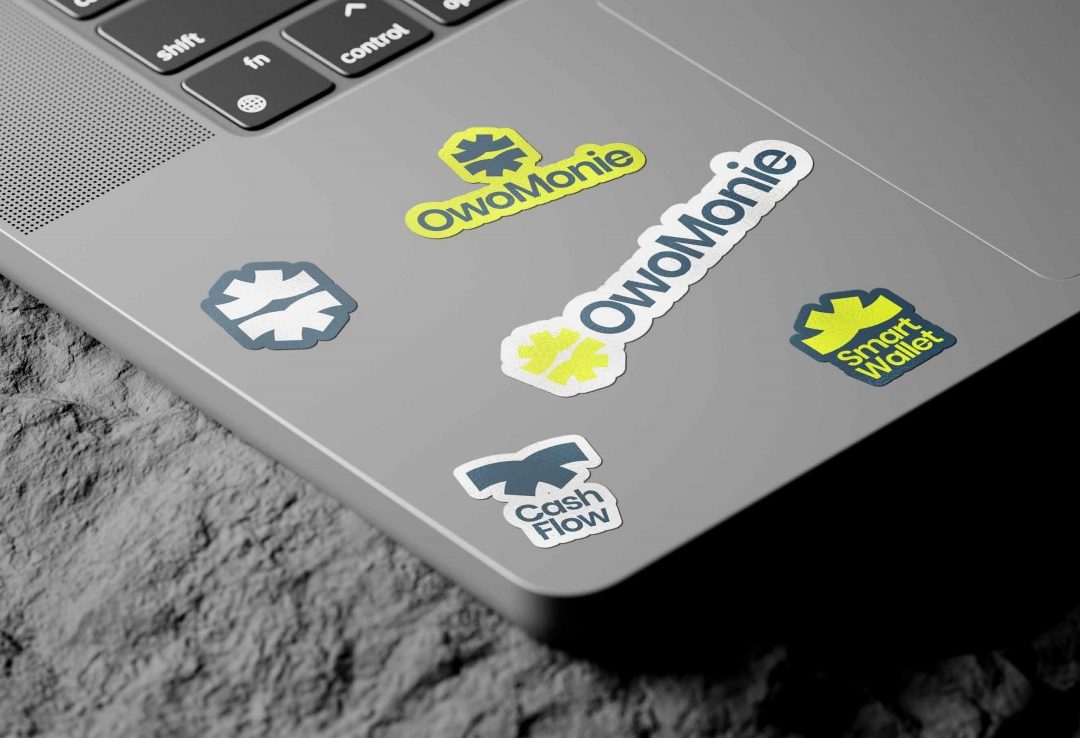
A modern, minimalist logo symbolising the flow of transactions and centralisation.
Typography
Clean sans-serif fonts that stay readable across digital platforms.
Colour palette
Both are balanced with neutral tones.
The OwoMonie brand embodies simplicity and empowerment: financial management made approachable.
Strategy and positioning
Competitive positioning
- Identified gaps in existing finance apps around personalisation and community engagement
- Positioned OwoMonie as the culturally relevant, approachable alternative to complex tools
- Developed brand messaging around empowerment and financial clarity
Target audience
- Young professionals
- Small business owners
- Students
- Messaging frameworks for each segment, addressing specific pain points
- A community-building strategy as the key differentiator
Go-to-market planning
Phased launch
An outlined launch approach starting with early adopters.
Pre-launch awareness
A content marketing and social media strategy.
Partnerships
A partnership strategy with financial literacy organisations.
Product design
To simplify personal finance management, the design prioritised three things.
Clear navigation
Users can quickly find tools for tracking, budgeting and forecasting.
Data visualisation
Interactive charts and graphs make spending and income patterns easy to understand.
Personalisation
Budgets and recommendations tailored to user goals and financial habits.
Key features
Comprehensive tracking
Visual dashboards for income, expenses and investments.
Financial forecasting
Predictive analytics made accessible through simple tools.
Community tab
A dedicated space for user interaction and expert advice.
Bank integration
Smooth account linking for real-time updates.
Every design choice was rooted in one goal: making personal finance accessible and actionable for every user.
Design and development process
While development is ongoing, the design phase laid a strong foundation through an iterative process.
Prototyping
Early wireframes and high-fidelity mockups gave a clear blueprint for the app’s look and feel.
User feedback loops
Usability testing with a sample audience refined navigation, data visualisation and interactive elements.
Collaboration with developers
A seamless handoff of design assets, aligned on feasibility and functionality.
Key focus areas for development
Data security
Secure integrations with Nigerian financial institutions to protect user information.
Responsive design
Smooth functionality across devices, from mobile to desktop.
Feature scalability
A framework that allows future enhancements such as advanced analytics or expanded integrations.
Outcome
The product is still in development, so these are the anticipated outcomes.
Enhanced financial clarity
Users gain a clear understanding of their financial health through intuitive tracking and visualisation tools.
Personalised budgeting success
Tailored budgeting features help users meet their financial goals with ease.
Community engagement
A robust community feature encourages knowledge sharing and a supportive environment for financial growth.
The brand strategy and positioning work has laid a strong foundation for market entry, with early user research validating the brand’s resonance with the target audience.
Ongoing learnings
The value of early feedback
Regular user testing during the design phase was invaluable in identifying pain points and improving the interface.
The importance of local context
Incorporating local cultural and financial nuances is critical to building trust with Nigerian users.
Flexibility in development
Designing for scalability lets OwoMonie adapt to future user needs and technological advances.
Thoughtful branding and design have laid the foundation for OwoMonie to meet its goal of empowering Nigerians to take control of their finances, with a focus on usability, cultural relevance and seamless integration.
Make your brand the obvious choice.
Your market is crowded.
The opportunity is to become the brand people remember when it is time to buy.